Gold Standard for Behavior Change? Experiential, Practice-Driven Learning
Knowledge alone doesn’t shift performance. Behavior does.
That’s why experiential, practice-driven learning is the gold standard for meaningful, lasting change.
Traditional training models often rely on passive absorption: presentations, slides, and discussions. While these methods can build awareness, they rarely translate into action. People may leave a session inspired or informed, but without the opportunity to practice in real time, new ideas struggle to take hold under pressure.
Behavior change requires something more active, more immediate, and more human.
Learning That Mirrors Reality
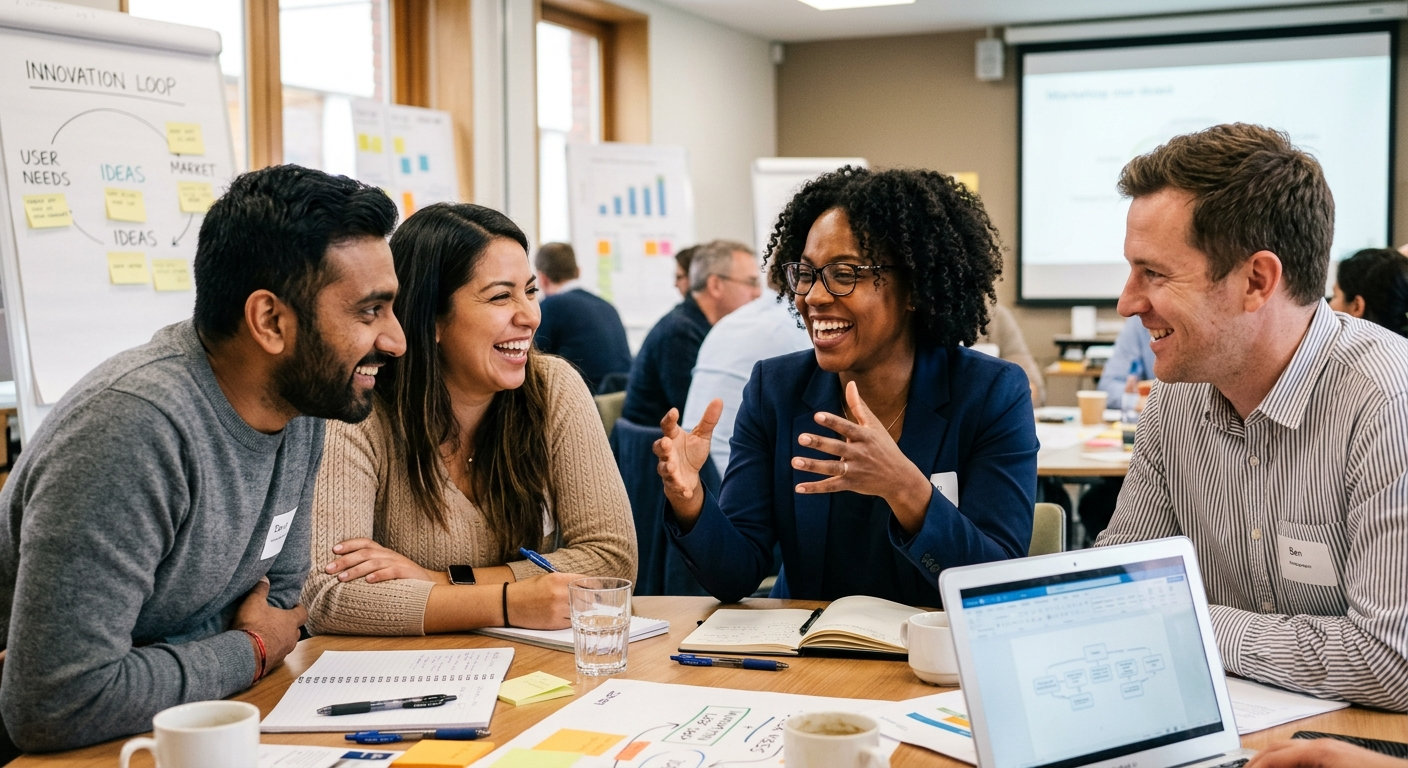
Experiential learning works to replicate the conditions where behavior actually happens. Instead of talking about leadership, or influence, participants are placed directly into scenarios where they must demonstrate those skills.
They experiment. They make choices. They see the impact instantly.
This is where practice-driven design becomes essential. Repetition, feedback, and iteration allow participants to refine their approach in a safe environment before applying it in high-stakes moments. It’s about getting more comfortable and more effective over time.
Experiential learning bridges the gap between knowing and doing.
Why Improvisation Is So Effective
At ImprovEdge, the tools of improvisation are at the core of this approach. Improvisation is about responsiveness, awareness, and connection. It places participants in unscripted, dynamic situations that resemble real workplace interactions.
In an improv-based learning environment, there are no scripts to rely on—just like in real conversations with clients or colleagues. Participants must listen actively, respond in the moment, and adjust based on what’s happening around them.
This creates a powerful learning loop:
- Action: Participants engage in a scenario that requires real-time decision-making.
- Feedback: Facilitators and peers provide immediate, targeted insight.
- Adjustment: Participants try again, applying what they’ve learned.
That cycle repeats quickly, allowing new behaviors to become more natural and instinctive.
Building Muscle Memory for Communication and Leadership
One of the greatest advantages of practice-driven learning is that it builds what can be thought of as “behavioral muscle memory.” Under pressure, people don’t rise to the level of their intentions—they fall back on their habits.
Improvisation helps shape those habits.
Through structured exercises, participants develop critical skills like:
- Listening to understand rather than to respond
- Adapting messaging based on audience cues
- Staying present and composed in uncertainty
- Building on others’ ideas to create alignment
These aren’t abstract concepts—they are practiced behaviors that become easier to access in real-world situations.
Meeting People Where They Are
Another strength of experiential learning, particularly as designed by ImprovEdge, is its flexibility. Participants enter with different levels of experience, confidence, and skill. Improvisation allows facilitators to meet people where they are and adjust in real time.
Because the work is interactive and responsive, facilitators can tailor scenarios, increase or decrease complexity, and ensure that each participant is both supported and challenged appropriately.
This adaptability is essential for driving engagement—and engagement is essential for retention and change.
From Insight to Impact
Ultimately, organizations invest in learning and development to see results: stronger leadership, better collaboration, more effective client interactions. These outcomes are from consistent, practiced behavior.
Experiential, practice-driven learning delivers that consistency.
By using the tools of improvisation, ImprovEdge creates environments where participants try new ideas, refine them, and own them. The result is a measurable shift in how people show up and perform.